The base liquid — soup
The body of the bowl, drawn from bones, poultry, fish or vegetables. It brings volume, heat and texture. On its own it stays nearly bland — on purpose.

Contents
Guide · Japanese food
The broth decides everything in a ramen — yet it is the part people look at least. Here is how it is really built: three layers, hours of cooking, and a clear difference between a broth drawn on site and a reconstituted powder.
11 min read
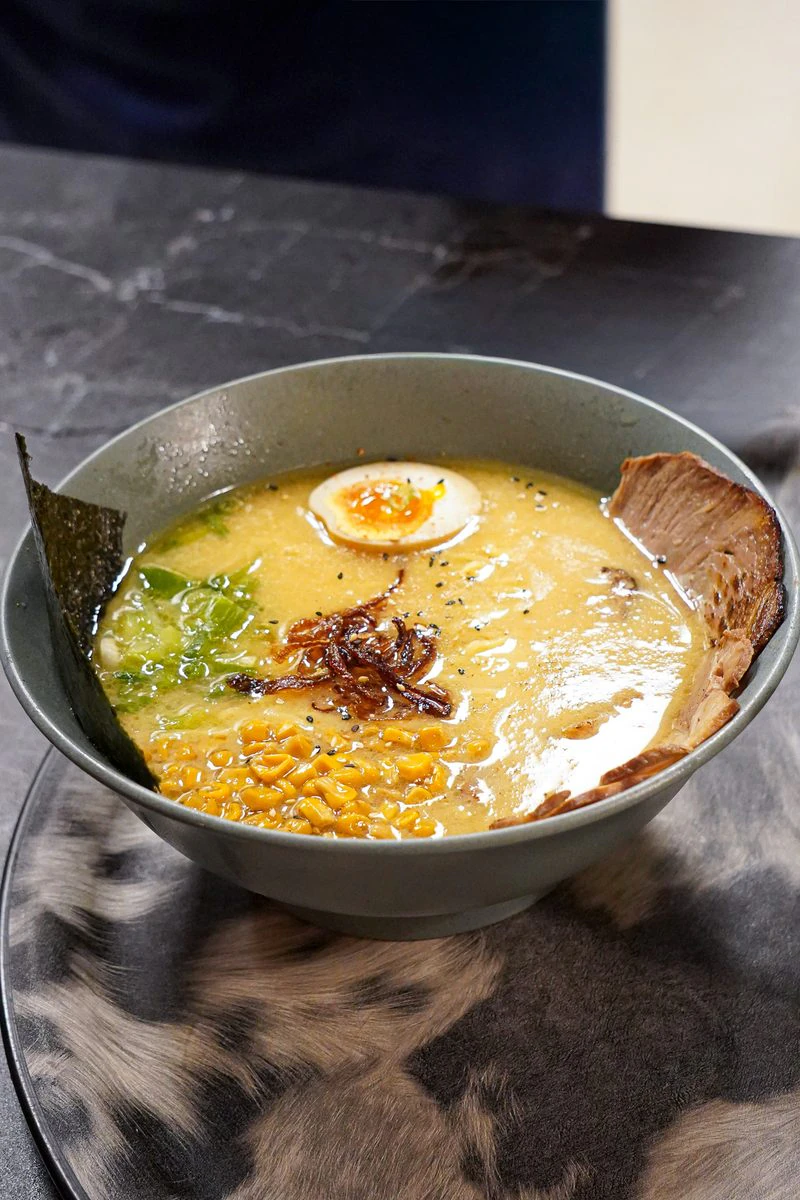
A homemade ramen broth is not a soup: it is a three-layer build — the base liquid (soup), the seasoning concentrate (tare) placed at the bottom of the bowl, and the aroma oil on the surface. Clarity or opacity comes from the boil, not an additive: a gentle simmer gives a clear broth (chintan), a hard, long boil emulsifies fat and collagen into a cloudy broth (paitan). Cooking times are physics, not marketing: minutes for a marine infusion, hours for a clear broth, much longer for a cloudy one. It is the tare, not the broth, that names the bowl (shoyu, miso, shio). To spot a house-made broth: a short, stable menu, an open kitchen, a broth that coats the spoon and salt that does not saturate.
The starting point
A bowl of ramen is roughly 20% noodles, 15% toppings and 65% liquid: the broth decides almost everything you taste. We admire the chashu and count the slices, but the heart of the bowl, by volume and by flavour, is that hot liquid most eaters treat as a mere support.
The aim here is simple: understand the three layers of that liquid, know the real cooking times behind each broth, and learn to tell a broth drawn on site from a reconstituted base. You may never cook one yourself — the point is to know what is in your bowl and why it takes so long.
A quick reminder first: ramen is noodles in broth, not a garnished soup — if the word feels vague, start with what a ramen really is. This article picks up from there and goes one level down, to the bottom of the pot.
The distinction
A European soup is usually seasoned in the pot, then served. A ramen broth works differently: the base liquid is drawn almost neutral, then meets a concentrate and an oil that carry the salt and the aroma, in the bowl, at the moment of service.
This is why one broth can yield dozens of ramen, and why a great broth can be ruined by bad seasoning. Understand the three layers and you understand the rest.
This layered build is not a recent trend: it comes from early-20th-century Japanese stalls, where fast service split the slow base from the à-la-minute concentrate. For that lineage, see the history of ramen.
The three layers of a bowl
The body of the bowl, drawn from bones, poultry, fish or vegetables. It brings volume, heat and texture. On its own it stays nearly bland — on purpose.
Placed at the bottom before the broth. It brings the salt and the character, and names the ramen (shoyu, miso, shio). Without it, the bowl is flat.
A scented oil on the surface: charred garlic, shallot, sesame. It insulates the heat, carries aromas to the nose and adds shine.
In the pot
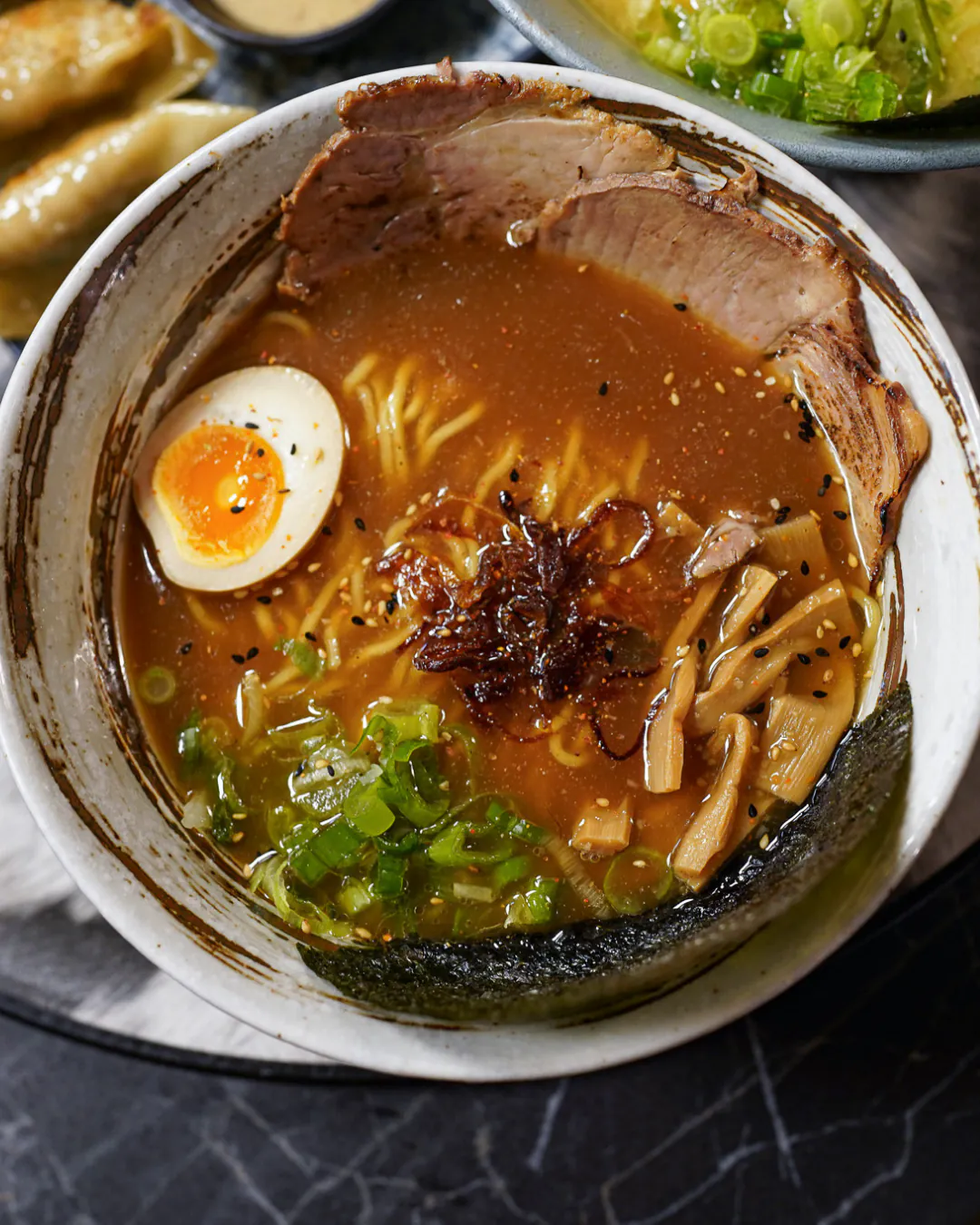
Animal broths split in two, and the line is the flame, not a secret ingredient. A chintan is clear: drawn at a gentle simmer so fat and impurities rise and are removed. The liquid stays limpid and amber — the base of Tokyo-style shoyu and shio.
A paitan is cloudy and milky: pushed to a hard, long boil so fat and collagen break into a suspension that coats the spoon. Nothing is added to whiten it — the opacity is the visible sign of long work over high heat. Two boils, two opposite bowls, from the same bones.
The sea in the bowl
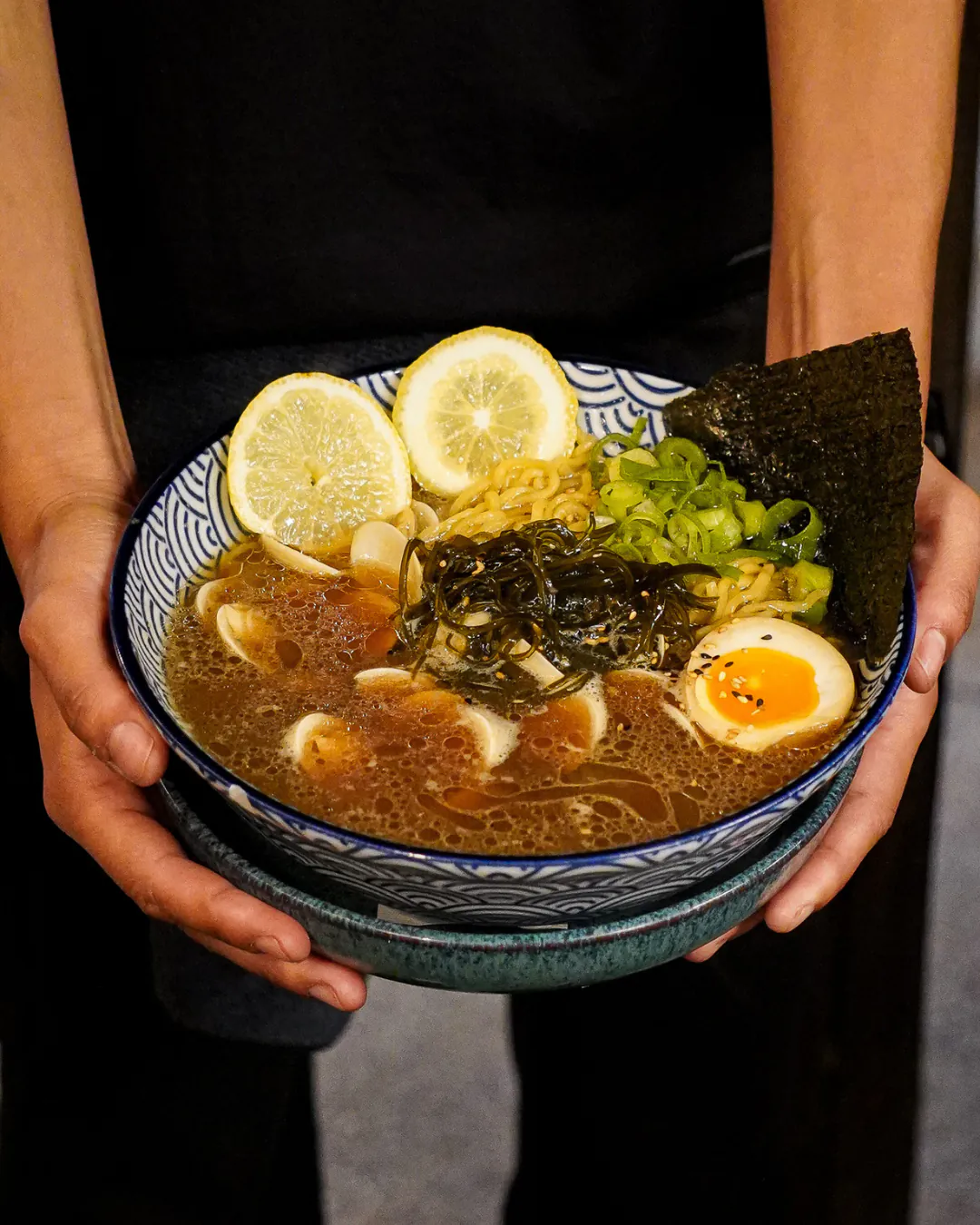
Marine bases follow the opposite logic to meat broths. Dashi — kombu and katsuobushi — is infused, not boiled for hours. Kombu must never boil: it turns bitter and slimy. You bring it up slowly, remove it before the boil, then steep the bonito for a few minutes off the heat.
The rule: marine broths are worked short, by infusion; meat broths long, by extraction. Shellfish belong to the same family — a brief cooking draws a clean iodine and saline depth without ever forcing it.
This is exactly the spirit of a clam asari ramen: a delicate, almost consommé-like broth where short cooking protects the marine freshness.
Meat-free
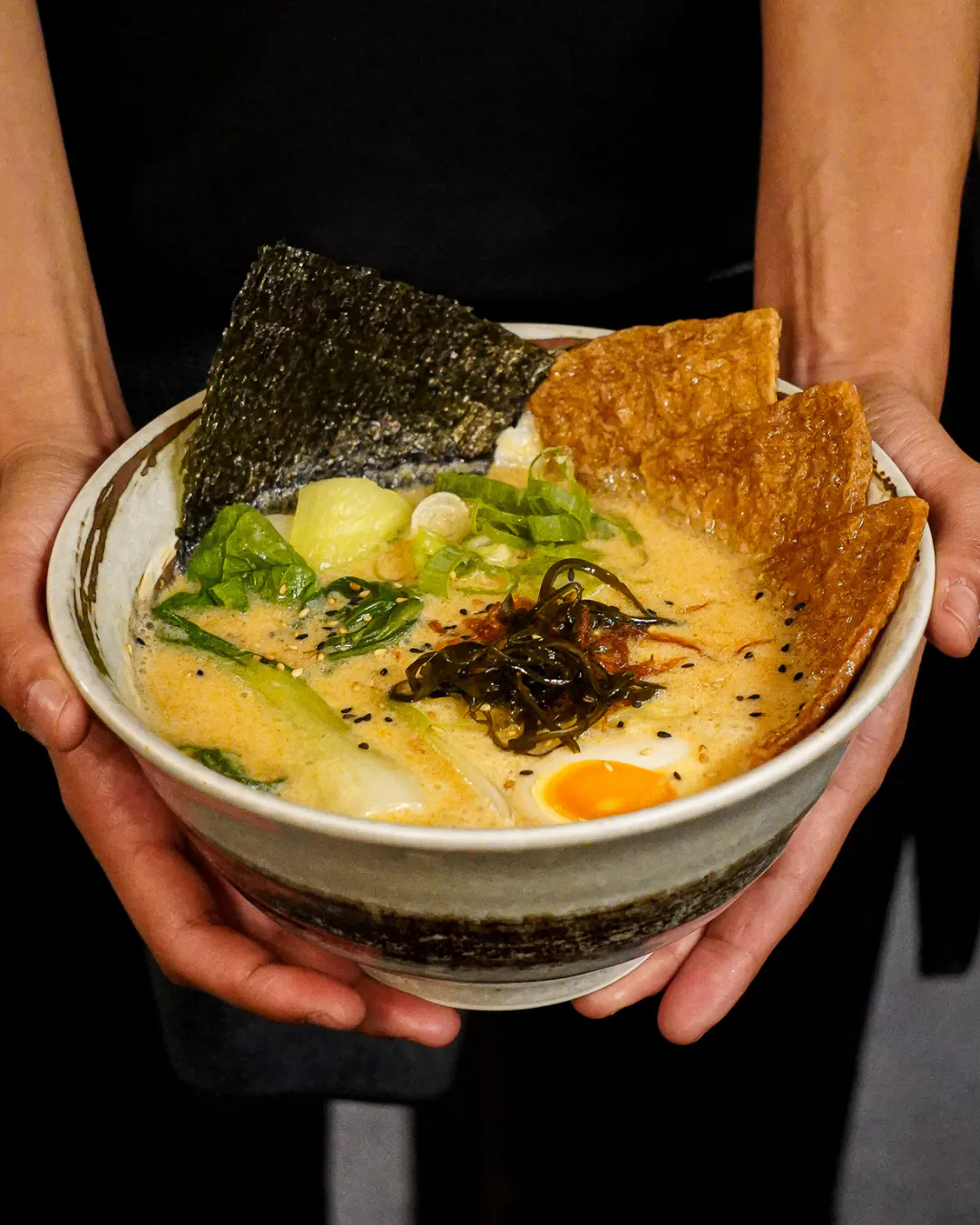
A vegetable broth poses a real challenge: umami and body without the animal fat that does the work elsewhere. You layer umami sources — dried shiitake, kombu, tomato, roasted vegetables — and find texture through purées, seeds and scented oils.
The trap is a hollow mid-palate: a liquid that starts well then fades. A good vegetable broth is built in layers of intensity, like a meat broth but with a different palette. Not a lesser version — a different cuisine.
At Iwao this takes the form of a yasai miso ramen, where miso brings the salty depth and the vegetables the freshness.
The constraint
The honest answer: it depends on the broth, and no time is magic. Cooking time is not marketing but physics. Collagen only turns to gelatin after hours; a paitan emulsion only forms with sustained boiling; fragile dashi aromas would vanish if boiled. Each duration answers a phenomenon.
The figures below are orders of magnitude, not rules — they vary with the bones, the pot and the goal. What they say is that a real broth occupies a kitchen for much of the day, and no shortcut fully replaces it.
Dashi and shellfish: infuse, do not boil. Too much heat or time turns the iodine bitter.
At a gentle simmer, until collagen gelatinises and the liquid gains body without clouding.
At a hard boil, far longer, until fat and collagen emulsify and whiten the broth.
The concentrate
Here is what most eaters miss. The tare is a seasoning concentrate — a few spoonfuls — placed at the bottom of the bowl before the broth. Invisible under the liquid, it decides the salt, the length and the name of the bowl. The broth gives the body; the tare gives the identity.
It explains a paradox: two ramen-ya can start from the same broth and serve two different bowls. Change the tare and you change the ramen without touching the pot — which is why a great broth seasoned too early or too hard loses everything.
The name follows the tare. A soy tare makes a shoyu ramen, clear and saline; a miso tare makes a miso ramen, rounder and denser; a salt tare makes a shio, all transparency.
We stay on the mechanics here, not the flavour comparison: to contrast the two schools in detail, see our guide on the difference between shoyu and miso ramen.
Bowl by bowl
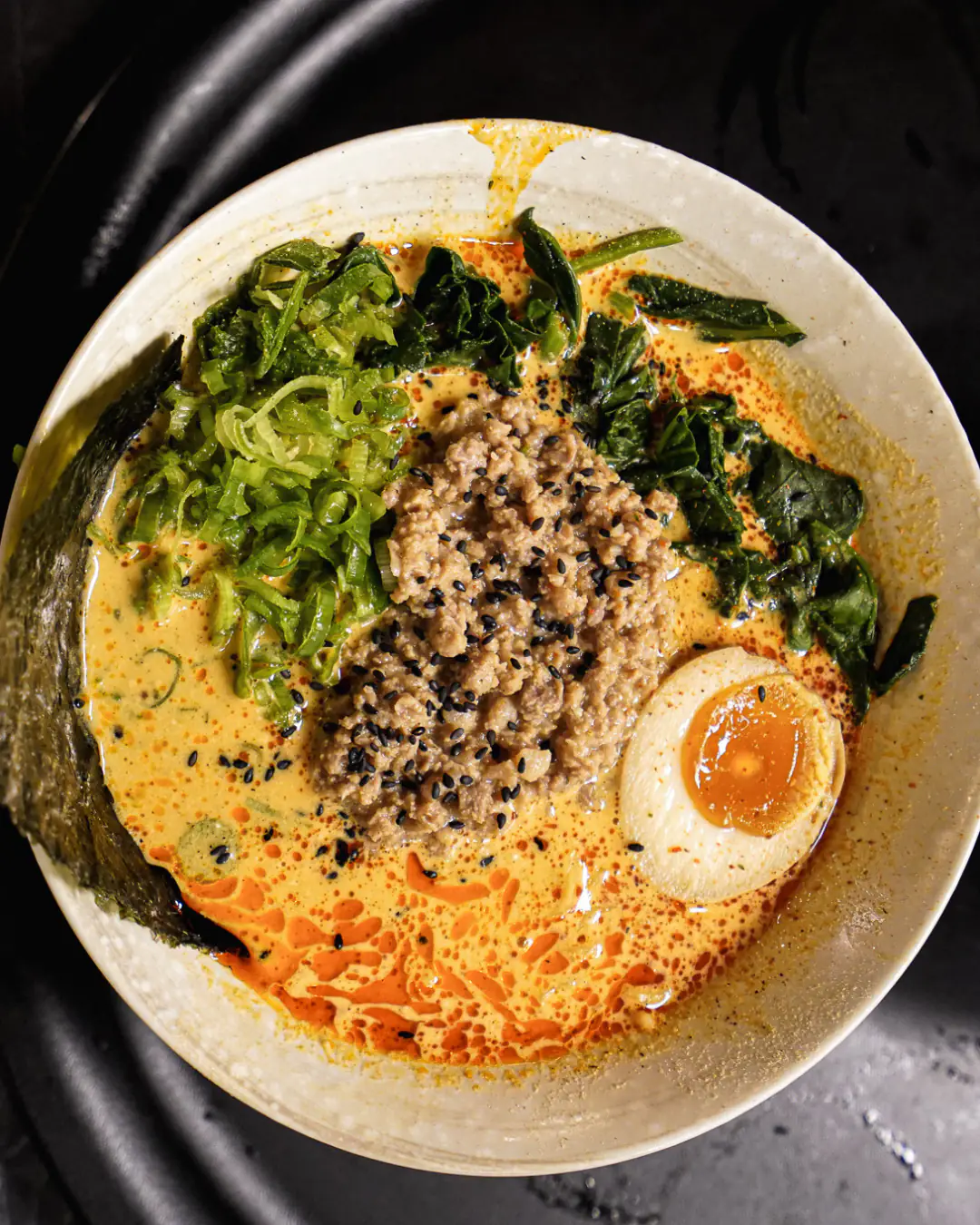
Choosing a ramen broth means choosing a balance between the three layers: the base liquid, the tare and the aroma oil. Iwao's menu shows it in practice. Three bowls, the Shoyu, the Miso and the Tantanmen, start from the same chicken broth: the tare and the oil set them apart. The other two change base entirely, marine for the Asari, plant-based for the Yasai Miso.
Read the grid line by line: the first row gives the body, the second the name and the salt, the third the aroma on the surface. The compositions below are those of the menu, as served on rue Sainte.
Soy tare and a marine note from the oil on a poultry base.
See the bowl ShoyuSame base as the Shoyu, but a miso tare that rounds out and thickens the bowl.
See the bowl MisoSesame paste thickens the base; the rayu makes it the only spicy bowl on the menu.
See the bowl TantanmenA marine base, cooked briefly to keep the iodine fresh.
See the bowl AsariSoy milk brings the body that animal fat provides elsewhere.
See the bowl Yasai Miso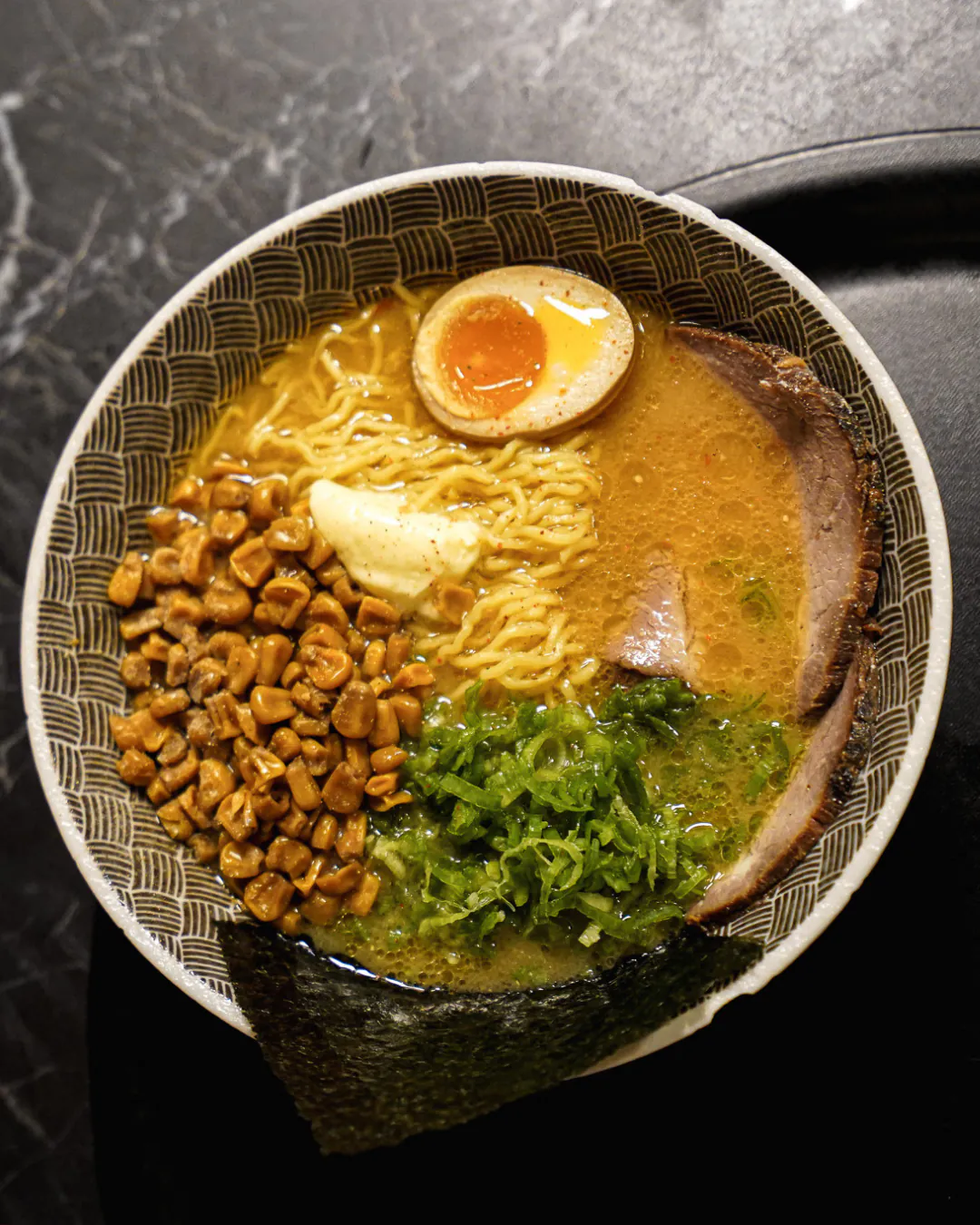
The support
A ramen noodle is not Italian pasta. It is defined by kansui — an alkaline water that gives the noodle its yellow colour, elasticity and the snap under the tooth. Without kansui, no real ramen noodle.
Fresh or dried, the difference is real. A fresh noodle cooked to the minute keeps a spring a rehydrated dried one struggles to match, and it suits a broth drawn on site. It also keeps absorbing liquid in the bowl, so it swells and softens fast — hence a ramen is eaten quickly.
That tempo also governs the gestures at the table. If it interests you, it is all in our guide on how to eat a ramen.
As a customer
You do not visit the kitchen before ordering, yet a few clues, spoon in hand, do not lie. A house-made broth lightly coats the spoon and leaves a thin fatty trace — collagen and aroma oil. Its salt does not saturate: it carries the taste rather than crushing it, unlike a reconstituted base with its flat, uniform saltiness. An open kitchen with steaming pots, and light seasonal variation, signal a living production.
The most reliable clue is menu length. It is materially impossible to hold thirty house-made broths — each takes hours of pot and a spot on the flame. A menu of a few ramen is often the sign of a house that truly draws its own bases.
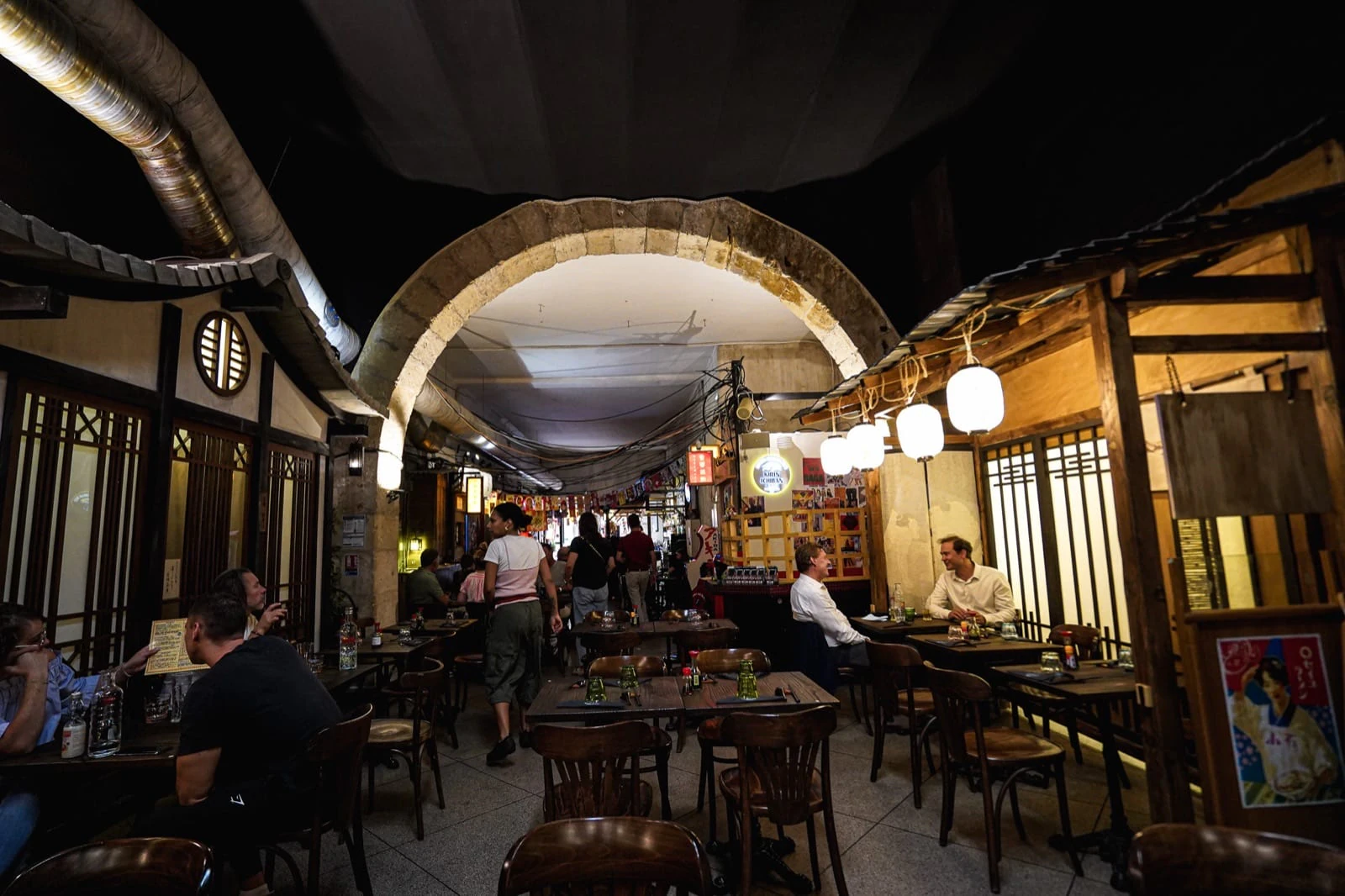
That is exactly the case on rue Sainte, Marseille (13001), where Iwao, authentic ramen in Marseille, keeps a short, stable menu — five signature ramen (Shoyu, Miso, Yasai Miso, Asari, Tantanmen) plus a children’s ramen, among the five bowls of the menu —, with broths made on site and an open kitchen visible from the room.
In summary
Remember the three layers: the base liquid for the body, the tare for the name and the salt, the aroma oil for the scent. And remember that a broth’s time is a necessity, not a pose — collagen, emulsion and extraction are not negotiable. A house-made broth is, in that sense, a mark of craft.
Next time a bowl is set in front of you, you will read what it says. And to check it spoon in hand, there is a place for that: the authentic ramen in Marseille is drawn every day on rue Sainte, facing the room.
FAQ
Explore
Iwao’s broth from other angles, and the rest of the house.
A broth is best understood spoon in hand. To see the pots finish simmering and taste a base drawn on site, push the door of a real ramen-ya: authentic ramen marseille happens on rue Sainte, facing the open kitchen.

Stage clear — table booked
The best way to understand a broth is to taste one, made on site and served piping hot. Book your table at Iwao and watch the bowl come together in front of you.
Or by phone: +33 4 91 54 08 27
