The one-shot
A full story in one volume: a beginning, middle and end over a meal, with no thirty-book commitment.

Contents
Guide · Reading & manga library
Reading a manga while your broth simmers, turning a page between bites: at Iwao the manga library is part of the meal. The trick is picking a title that fits a service — one that reads in fragments and puts down gladly when the bowl arrives.
9 min read

To read at the restaurant, pick a manga that reads in fragments: a one-shot, short episodic chapters or a yonkoma (four panels) all put down and pick back up without losing the thread. Food manga — Oishinbo, The Solitary Gourmet, Food Wars — are the obvious companions to a bowl of ramen, while slice-of-life (Yotsuba, Non Non Biyori) sets a gentle tempo for the wait. Big shōnen dip well, one chapter at a time. Remember the Japanese reading order — right to left. The rule: a good table manga reads one-handed and never makes you forget your ramen.
The right reflex
Between ordering and the bowl steaming in front of you, there is a suspended moment that calls for reading. Manga is the ideal companion: cut into panels, quick to read, it is devoured in short bursts, opened while you wait and closed when the plate arrives.
In Japan the habit even has a place — the manga-kissa, cafés walled with volumes. At Iwao we picked up that thread: reading at the restaurant is not isolating, it extends the immersion. You just need the right title, which is what this guide is for.
At our place
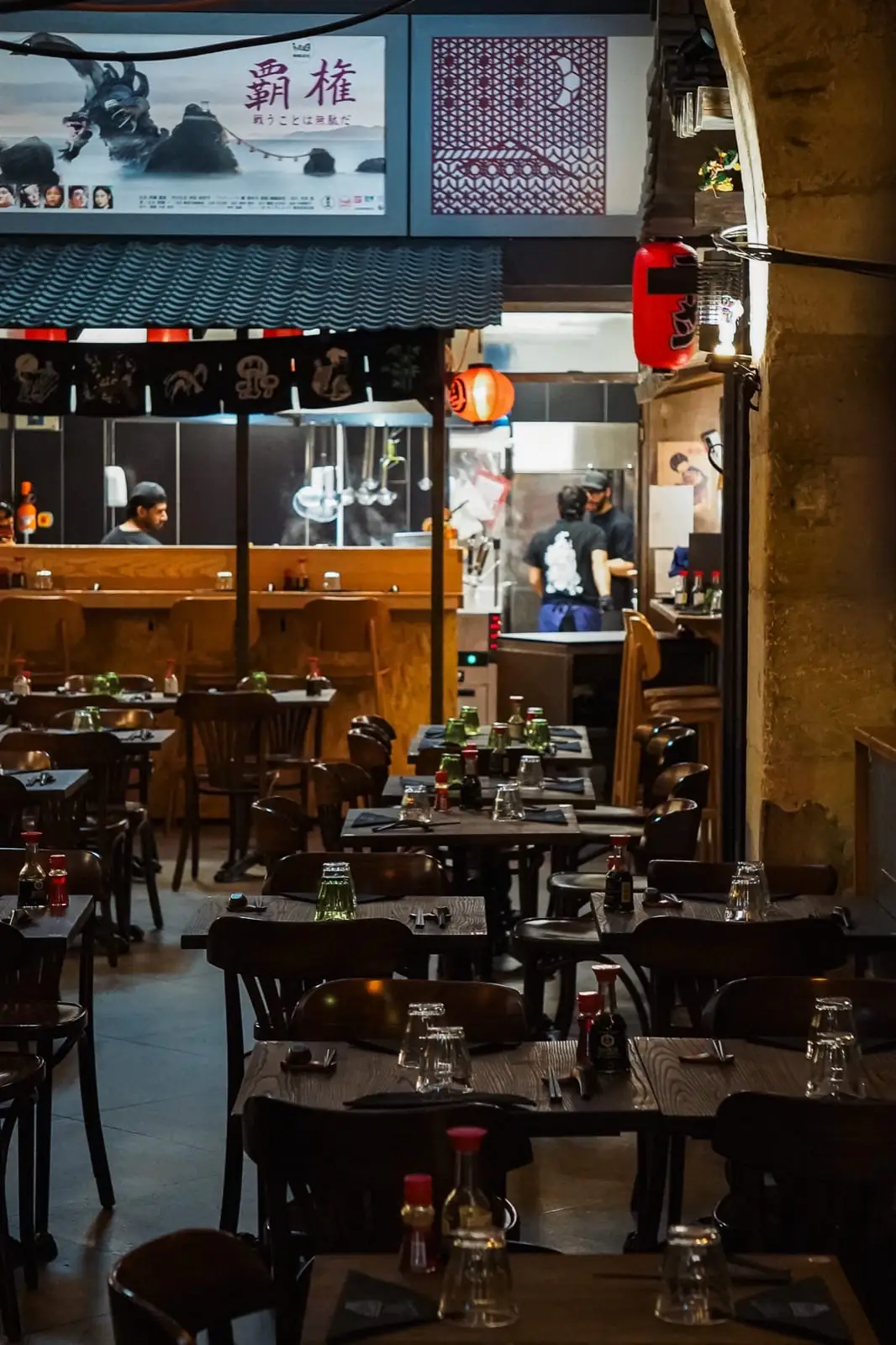
At Iwao, 27 rue Sainte in Marseille, the manga are within reach along the recreated Tokyo alley. Pull a volume, sit at the counter facing the open kitchen, and read — like a manga-kissa, but with a steaming bowl of ramen too.
The selection mixes genres on purpose: cult series, hidden gems, food manga of course. One rule of use: you read, you put it back, you don’t leave with it. That circulation — a volume passing hand to hand — is the spirit of the place.
Avant de commander, prenez un instant pour parcourir les rayons de notre mangathèque: la sélection change au fil des envies, et il y a toujours un titre pour accompagner votre bol.
The crux
Before genre, format decides whether a manga reads well at the table. Your reading will be interrupted, so the good table manga survives interruption. Three formats excel: the one-shot (a full story in one volume), episodic short chapters, and the yonkoma — four panels, a gag, a punchline. A long saga still works, but read in slices across visits.
A full story in one volume: a beginning, middle and end over a meal, with no thirty-book commitment.
Episodic series where each chapter stands alone. Read one, eat, read another — the thread never breaks.
Four panels, a gag, a punchline. The shortest format there is — perfect for the two minutes before the bowl.
The obvious ones
A whole genre — gourmet manga — is devoted to food, the dream companion for a bowl of ramen. Three titles lead: Oishinbo, the erudite monument; The Solitary Gourmet (Kodoku no Gourmet) by Taniguchi, where each chapter is a meal — the most fitting for the table; and Food Wars, turning cooking into a shōnen tournament.
These manga sharpen appetite and attention: you look at the arriving bowl differently. It is the most on-theme read in a ramen-ya, and often the ideal gateway for anyone who has never opened a manga.
The gentle tempo
A little girl’s wonder at the world, a chapter per day. Funny, tender, no dramatic stakes: stop whenever.
The Japanese countryside in slow motion. Almost contemplative — made for a peaceful wait.
Many mangaka publish standalone short stories. One per pause: the format ignores interruptions.
At the opposite of frantic action, slice-of-life cultivates slowness: no one saves the world, you follow ordinary lives. Perfect for the restaurant — you can stop anytime and pick up later with nothing lost. Yotsuba&! and Non Non Biyori are gentle highlights that accompany rather than grab you.
The essentials
You might think long action sagas suit meals poorly — you can’t catch up a hundred chapters over dinner. But their structure helps: shōnen is serialised, each chapter ends on a hook, each arc is a block. Grab a volume, read one chapter, come back next visit.
One Piece, Naruto, Dragon Ball, Attack on Titan, My Hero Academia sit in nearly every manga library: universal, rhythmic, instantly readable even mid-run. For a rushed reader or a child at the table, a well-chosen shōnen is a safe bet.
For the curious
Seinen is for adult readers: darker, slower, richer. Not the first reflex at a table, but under the warm lantern light some titles gain a special flavour — read less for plot than for mood, a page you reread.
The author of The Solitary Gourmet also signs contemplative, gentle stories. A line to admire between bites.
Horror in short standalone tales. Each reads in one go, a guaranteed chill, with no series to commit to.
Japan crossed on foot, by train, table to table. A slow change of scene that suits the room.
Edo era, samurai, artisans: dense frescoes to read by chapters when you have time to linger.
The first step
Never opened a manga and the shelf intimidates you? The restaurant is the best place to begin, precisely because you can try without committing: pull a volume, read ten pages, put it back. No pressure, no purchase.
Three paths work nearly every time: a food manga for the immediate echo with your bowl, a one-shot to taste a complete story, and a famous shōnen for sheer efficiency. Whatever you pick, start with volume one or a collection — nothing is more discouraging than landing at volume fifteen with no context.
The Solitary Gourmet is perfect: each chapter is a meal, reads in any order and echoes your plate.
A story wrapped in one volume. Discover the medium without getting lost in a long series.
Take volume 1 of a cult title. It’s popular because it’s immediate: the hook lands on page one.
The manual
One detail throws off every beginner: manga reads backwards to our habit. You open it from what looks like the last page and move right to left, panel by panel. Most French editions keep this original order to respect the author’s layout.
In a double page, start top-right, then zig-zag down toward the left; the speech bubbles follow the same path. The first minutes surprise, then the reflex settles. Many volumes even print a “Stop, you’re holding it the wrong way” note on the Western last page.
A little vocabulary helps: a tankōbon is a bound volume, a chapter is a wa, and onomatopoeia are part of the art. None of it is essential — but knowing which side to open from spares you the only real false start.
At our place
At Iwao the steps are as simple as you’d hope: sit down, order your ramen, and help yourself from the shelves while the broth is made. The counter facing the open kitchen is the best seat — read one-handed, watch the cooks with the other.
One closing tip: don’t try to finish a series in one go. The pleasure is in the back-and-forth — a page, a bite, a chapter, a sip. Let the manga pace the meal, put it down when the bowl steams, pick it up over tea.
FAQ
Explore
Iwao's reading and pop culture from other angles, and the rest of the house.
This guide is part of the house notebook, where we write about ramen, sake, table etiquette and Japanese pop culture, one topic at a time. Find every article in our Japanese food blog, and read them bowl in hand.

Stage clear — table booked
The best way to read a manga at the restaurant is still to come pull one off our shelves, a steaming ramen in front of you. Book your table at Iwao and come turn a few pages.
Or by phone: +33 4 91 54 08 27
